Thursday, March 24, 2011

The schedule of a Buddhist monk

On a weekend I climbed for a few hours to stay overnight in one of Bhutan's 2000 monasteries: Dho Dhey Drak (meaning 'place with rocks and cliffs'). Human settlement has occupied this place located for long time, but in 1986 a Buddhist Institute was established here currently hosting 170 monks from the age of 10 up to 29. Students come from all over the country to study Buddhism from four teachers. There is a guest house for visitors, but it was occupied by a family, so I shared the room with three monks.

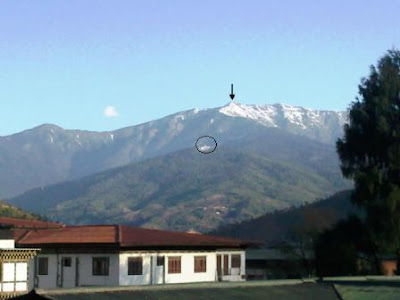
Dho Dhey Drak from Buddha point over Thimphu
A closer look.
One of them was my guide for the two days who had joined the Institute only two years ago. We had a great discussion about Buddhism in general and life at Dho Dhey Drak in particular. Before you decide to become a monk student, please read his daily schedule:

Weekdays:

4-5am: waking up and studying in the room
5-6: morning pray
6-7:40: lessons in the classroom
7:40-8: morning tea
8-9: lecture in the classroom
9-10: repeating what was studied the morning
10-10:15: break
10:15-11:30:lessons in the classroom
11:30-12:30: lunch
12:30-13: handwriting class
13-14: learning to play musical instruments or make rituals and ritual cakes
14-15: English lesson
15-16: studying on his own
16-17: repeating what was learned today
17-17:30: dinner
17:30-19: evening pray
19-19:10: break
19:10-22:00: evening studies and going to bed

On weekends: taking care of the compound; washing clothes, cleaning the rooms; playing sports like football or badminton; and having hot stone bath (stones heated on open fire are placed in cold water in simple wooden bathtubs)


Strictly forbidden for monk students to 1) challenge the teacher; 2) leave the premises without a permit; and 3) steal. In addition, there is no sex, smoking, drugs, and alcohol. And of course they have to follow the daily schedule.

What do they study ? Memorizing liturgical texts in Classic Tibetan language, known in Bhutan as Chöke. How to behave as a monk. How to play musical instruments. How to conduct rituals. How to write poems. English language.

Recently I heard it is considered to integrate math and sciences and more English into the curriculum to help monks get a job in case they decide to quit the monastery. It is probably a good idea, at the same time I met a few geytays (monks who gave up monastic life) and they seem to be successful in their new secular life. I was even told that the best businessmen in Bhutan are former monks. 


Former monks or not, my experience is that there is more room for creative and hardworking entrepreneurs in Bhutan.

Sunday, March 20, 2011

Unique to Bhutan - The Languages

In Bhutan, the official language is Dzongkha meaning "language of Dzong" meaning "language of fortress-like monastery". Originally used as the language of popular communication since the 17th century, especially in western Bhutan, it was only declared the country's official language in 1971. Linguistically, Dzongkha is a South Tibetan language. Although spoken Dzongkha and Tibetan are very different, the literary forms of both are highly influenced by the liturgical Classic Tibetan language, known in Bhutan as Chöke (choekey). 

Besides Dzongkha, there are around 18 other local languages in the country, including Nepali in the south. Visiting Ura located in the middle of the country I had dinner with a local family and my Bhutanese colleagues were sitting like me equally unable to understand a word of the conversation in local dialect.

File:Languages of Bhutan with labels.svg
Languages of Bhutan (Wikipedia)


Although English has no official status, it is taught at schools and widely spoken, especially in towns, where some people even speak better English than Dzongkha. It is also fairly common to hear educated people casually mixing the two languages when speaking. In Mongar I heard a minister discussing his itinerary with his team in this mixed way. Currently, there is intensive public discussion about the use of two main languages and how to preserve the role of Dzongkha when experiencing greater and greater English influence. The government even set up a development commission to pursue this goal.

Other interesting thing about hearing English spoken in  Bhutan is the use of the word "la" at the end of the sentence as a sign of respect. A typical phone conversation could be something like that:

"Kuzuzangpo-la"     (Good morning)
"Kuzuzangpo-la"
"Where are you going, la?"
"From Thimphu to Paro, la. I'll be back to Thimphu tonight. We can have dinner, la."
"Okay, okay"

What I have also noticed is that most people just suddenly end the phone conversation when they feel everything has been discussed without saying something like 'bye' or 'see you'. For the first time it sounded a bit rude to my chilip ear (chilip = foreigner), but now I'm used to it.

The last thing I would highlight is the habit of covering one's mouth when speaking to a person of perceived higher status or giving offering at temples. I heard that the reason is to prevent bad mouth smell from spoiling the environment.


To hear people speak Dzongkha, listen to the online radio, Kuzoo FM.

To read more unique things in Bhutan, click here:  NAMES  or  DRESS, DOMA, ETC  or PENIS

Friday, March 11, 2011

Unique to Bhutan - The Painted Phallus

I bet there is no other airlines in the world that offers an in-flight magazine that you innocently open and inside you find a half-page picture of this kind:


This is Drukpa Kunley, the 'Divine Madman', and his 'divine thunderbolt of wisdom' as appeared in the last issue of Tashi Delek, DrukAir's in-flight magazine. But who was Drukpa Kunley  and what did he do for Bhutan? 

A Buddhist master, he lived between 1455 and 1529 and he came to Bhutan from Tibet in the 15th century as Yogi Kunga Legpai Palzangpo to teach local folks about Buddhism in a fairly unorthodox way by using provocative and entertaining poetry, songs, dance, and humor, often combined with drinking and having sex. He occasionally applied all of his teaching methods with his hosts' wives, too. 

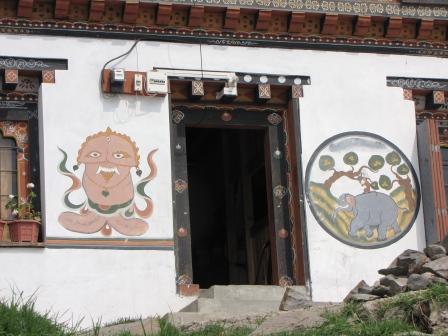
One of his very visible and distinctive legacies is the Penis painted on houses across the country in various shapes, sizes and forms. Other is Chimi Lhakhang, a temple established by his relative in 1499, where lamas today bless you with a wooden or stone phallus helping you have a child. Hopeful local and foreign women and men visit the place for the blessing and some of them stay overnight to test the power of ritual on the spot.

When Bhutanese asked about the reason for painting erected and ejaculating penises on homes or hanging wooden ones from the roof, they claim that they protect the house against deities and bad spirits. I don't know if it works, but it surely shocks many tourist getting out of their minibus wishing for a nice rest at a roadside restaurant. I heard a story from a tourist guide who was visiting the countryside with a British man and his 16 years old daughter. When the man asked my friend what that hanging piece of wood there was, he was so embarrassed to say it was a penis in front of the girl that, instead, he said "It is your Thing, sir."

The tradition of  provocative and shocking Buddhist teaching well demonstrated by Drukpa Kunley lives on today. I heard about a lama having a family visiting him and then in the middle of the meeting showing them a porn movie as a way of making them realize the truth of life. This story may be an urban legend, but modern interpretation of 'divine thunderbolt of wisdom' can be seen on walls all over the country.The penis motif is also manifested in jokes like this one from the online Bhutan Times:

THE REQUEST:

I, the penis, hereby request a raise in salary for the following reasons:

I do physical labor.
I work at great depths.
I plunge head first into everything I do.
I do not get weekends off or public holidays.
I work in a damp environment.
I don't get paid overtime I work in a dark workplace that has poor ventilation.
I work in high temperatures.
My work exposes me to contagious diseases.

THE REPLY:

Dear Penis,

After assessing your request, and considering the arguments you have raised, the administration rejects your request for the following reasons:

You do not work 8 hours straight.
You fall asleep on the job after brief work period.
You do not always follow the orders of the management team.
You do not stay in your allocated position, and often visit other areas.
You do not take initiative - you need to be pressured and stimulated in order to start working.
You leave the workplace rather messy at the end of your shift.
You don't always observe necessary safety regulations, such as wearing the correct protective clothing.
You'll retire well before reaching 65.
You're unable to work double shifts.
You sometimes leave your allocated position before you have completed the day's work.
And if that were not all, you have been seen constantly entering and leaving the workplace carrying 2 suspicious-looking bags.

Sincerely,
The Management


ATTENTION: the following pictures may disturb your peace of mind !

Modest size, discretely decorated
Oversized, with a dragon
Doubled, ejaculating water from a water-driven prayer wheel.
On the road to Wangdue Phodrang
From the inflight magazine of Druk Air
One from Ura
Another one from Ura
Other two.
Helping hands.
Hanging thing.
 

Hanging over the door.
What is he doing?
Drukpa Kunley is said to have decorated it this way.
Looks likes it meditates.

The tradition lives on in Thimphu

... and in Khoma village on the wall...
... and on a caramboard, local board game.

Click for more unique things in Bhutan:       NAMES     DRESS, DOMA, ETC

Saturday, March 5, 2011

A young Bhutanese actress and much more


Kezang D Wangmo is very humble and modest when it comes to discussing her achievements as an actress, singer, dancer, poet and goodwill ambassador for organic farming in Bhutan. Sometimes, it is her husband, Dorji Tashi, coordinator of Loden, who reminds us of her awards or special projects. She speaks in a non-celebrity manner with strength and concentration in her voice.  She is 23 years and 3 months old and she is planning the writing and production of her first movie.

Kezang was born in Paro, western part of Bhutan, and learned acting on her own at school performances and  watching Bollywood films made in India without any special course or teacher. She acted in her first film, a tragic-romance, in 2009 which immediately made her famous bringing her two national awards: the Best Female Lead Actor and the Best Newcomer. Since then, she has acted in five other films, but she was not as satisfied with her roles offered in these movies as in the first one.  ‘It was easy and natural to play in my first movie. I could simply be myself.’ – says Kezang hinting that the other films required her to fit into more common stories and characters.

Before becoming a well-known actress, Kezang already established her name as a singer through a local hit song ‘A  la la ngi sem’ and today she keeps getting invited to sing and dance at schools, national celebrations, and community events. In 2007, she submitted her poem to the prestigious National Poetry Competition of the Tarayana Foundation and won the first prize. Her piece was a tribute to the fourth king of Bhutan and later published with other selected poems by the Queen Mother Ashi Dorji Wangmo Wangchuck.

I went to see Kezang’s recent movie in which she played a non-lead role of an English teacher at primary school in the countryside falling love with a man who just came home from a long stay in London to rediscover his roots. "Bhutanese mainstream movies, like this one, target an audience educated on Bollywood. These long 160-minute or so films always tend to have the same storyline with lots of music and a break in the middle. Given the production time and low budget, theoretically I could make 6 to 12 such a movies a year, but with my other professional and family commitments, I can only afford three or so a year. For one movie, depending on the role, producer and whether the wardrobe is provided, I get a fix fee of 70-100 thousands Ngultrum, US$1500-2200." This means that Kezang’s payment is not linked to the number of viewers of her films, even if producing popular films in Bhutan is apparently a good business.
On the cover sold at a temporary cinema hall in Paro
Hearing about the Bollywood link I wonder whether there is a celebrity culture in Bhutan. "Currently, there is no celebrity culture here. People recognize me in the street and shops, but they don’t approach me for a picture or autograph. They stare at me only secretly; they behave as I was not there. However, it is slowly changing and when I’m invited to schools, kids want pictures and autograph. We also have sort of celebrity magazines, I was on the cover of one of them recently, and people call me to produce their commercials with me, but they can’t pay."

Surrounded by kids.

Kezang is vegetarian and in her free time she promotes Happy Green Cooperative, the country’s new organic farming and food movement, especially among youth as an alternative to moving to Thimphu where jobs are scarce. When asked about Hollywood actors she appreciates, the names of Kate Winslet and Julia Roberts pop up. When asked about future plans, Kezang enthusiastically starts talking about her dream project of scripting, producing and acting in her own film. "This will be a movie for both Bhutanese and international audiences. It will be beautiful and well-done."

I can’t wait to see it.


Surrounded by nuns.


Kezang D Wangmo: Beyond Praise

When your steps mark these mountain paths
many years from now,
stories will move the lips of those
you pass along the way.

As clouds gather nears the ridges of pine
below in his season’s yield
a farmer will tell you of wiser seeds
sown by one and one man tilled.

The school’s foundation
and the clinic’s wall,
the roads and the farms of our land,
blossomed to give us our health and hope
as the modern was grown by his hands.

He will speak of a leader
who like a powerful sword

would defend with clarity and grace
Against threats of militant action
Or corruption of inner space.

He will finish in whisper
of chaos like oceans,
how mountain storms gather
in confused explosion,

Of how one mans greatness
will be vivid and lasting
like the silence that comes
after the storms fierce passing,

Of a selflessness
that could endlessly reign,
of power grown great
by giving away.

But when your steps mark these paths
many years from today
the voices who praise
in spite of their phrases
will end in silence…

For beyond the sound of our voice,
and the word that we seek,
His majesty remains untouchable,
always above the praises we speak.
Copyright Ashi Dorji Wangmo Wangchuck 

Monday, February 28, 2011

Reaching Talakha Peak at 4241m

Last Sunday, I went to Talakha Peak which is a 4241m high peak not far from Thimphu. Our American-Catalan-Dutch-Hungarian team of five decided to rent a 4WD car with a driver to go to Talakha Monastery first and then climb up to the peak. We found a former policeman who said he had a 4WD, but he could not take more than four people. Finally, he asked if there was a woman in the group. I said yes. He said then it was fine, because six men in the car woud bring bad luck, but five with one woman was ok.

When we were to start in the morning we found out that the car was not 4WD and the driver had never been to the monastery. Given the condition of the dirt road leading to the goemba (monastery), it was a problem and meant about 80 minutes additional walking.

At the goemba a young monk voluntarily joined us to show the first part of the trail, then we continued relying on our Dutch friend who had been to the peak before and the local trekking guide book.

After having climbed over a wooden fence keeping yaks and their female partners, dris, out of the area, we met two Bhutanese men walking with a dog and a radio to their village in the mountains. From there we were going together up to the peak.

The last few hundred meters of the trail were very tough due to rocks and stones and snow, but all of us reached the peak, including our Catalan hero friend whose eye got injured in the bamboo forest. From the top we could see other higher peaks such as Jhomolhari (Bhutan's most sacred mountain, 7314m) and Kachenjunga in Nepal and India (8595m). In a clearer day one can even see the Mount Everest, but we couldn't.

Having limited time and dry coughing developed by few of us due to high altitude, we quickly started descending towards the goemba where friendly dogs welcomed us again. From goemba to goemba the 17 km return trip with 1300m elevation  took almost 8 hours. 

Did you know that Bhutanese regulations prohibit climbing any peak higher than 6000m? This makes the country have the highest unclimbed peak in the world: Gangkhar Puensum (7541m)

From Thimphu you can see Talakha Monastery and Talakha Peak
Our group of five. This photo looks like it was taken in the 80s.


Attacking the peak
Elevation of Talakha peak verified.

On the top with the two Bhutanese men we met on the way.
Going back to Thimphu waiting for us in the valley with hot shower

Tuesday, February 22, 2011

Creating a coffee culture in Bhutan


I'm sitting in one of the three cafes in Thimphu located on the main road, not far from the 'traffic' which in local jargon means the main junction where a policeman controls the ever growing traffic of cars. Once there were traffic lights installed there, but people reclaimed the policeman making Thimphu the only capital in the world without traffic lights.

But not a city without good coffee ! I regularly go to two coffee houses here, one next to the Loden office called Karma's Coffee run by Karma himself trained in Australia. The other I like is Ambient Cafe run by a family: Letho (28), his wife, Junu, and their 4 years old Jigme. Letho's wife makes excellent home-made cakes, Letho is the self-made coffee barista using an Italian coffee machine, and I'm not really sure about the role little Jigme plays.

Having run a restaurant and a small hotel for some time with limited success, Letho decided to change and launch Ambient Cafe in 2009. He was not sure if there was a market for another cafe in Thimphu given the lack of coffee culture with an estimated 70% of residents associating the word 'coffee' with instant nescafe.With his best friend who gave some good advice and came up with the name Ambient, they calculated that they had to serve around 12 cups of coffee a day to break even. Nowadays, on a good day, they sell even 100.

Letho had his first cup of coffee in India when studying at college in Bangalore. It was not love at first sight or neither first slip. The espresso they could afford in a coffee house chain was very bitter and quite strange for a Bhutanese who had got used to drink suja butter tea or tea with milk. A more positive influence came later from a Japanese guest at his hotel who brought good quality coffee with him and explained how to taste it and what made a good coffee. Letho got interested.

Letho, who has never visited any cafes outside India, instinctively and through his intensive Internet search follows the European way in his institution: laid back atmosphere, nice background music, Haiku contest for guests, WIFI, no rush. The only difference that he doesn't serve alcohol saying that it would increase the noise level too much.

When asked about his future plans, the young cafe owner is quick to state that he doesn't want to create a chain or become a millionaire. He just needs some money for his son's education and for travelling to Europe one day to check the old continent's cafés to improve his own. His business attitude seems to be perfectly aligned with the principles of Buddhist Economics.

At Ambient Cafe, you can have an espresso for 40 ngultrum when a suja costs 15 in the next local bar. However, avantgarde pioneers always pay the price when creating a new culture and here they apparently do it happily: guests voted the coffee shop to be the number one among Thimphu's restaurants.

Letho and little Jigme at the king's birthday celebration. 

Monday, February 21, 2011

The King's Birthday: he is young, bright, handsome and single


His Majesty The Druk Gyalpo (Dragon King) King Jigme Khesar Namgyel Wangchuck is 31 years old today. He is young, handsome, down-to-earth, very popular and ... unmarried. He is the 5th king of Bhutan and his photo is found in every home, office, monastery, and restaurant. He lives near Thimphu in a valley in a modest cottage house surrounded by forest and military guards. He studied in the USA and Oxford, he is a sports man and he spends lots of his time visiting his subjects around the country. He has been the king since 2006, crowned in 2008 by his father, the same year when the first democratic elections were held in the country. Today, Bhutan is a democratic constitutional monarchy where the king has a very important symbolic power.

Each year, there are two birthday celebrations of the king: a private one organized for a selected group of people and another public one held in the national stadium. Today, I went to see the second one. It was nice with dance performances of school children and a speech of the prime minister. I was a bit disappointed, though, because as it turned out, the kind doesn't attend this event. I really wanted to see and hear him.

Would you like to know more about the King? It is not easy to get information directly from him. Last time, I was asking his press officer if he could give an interview for my blog. He said it was not possible because his Majesty decided not to give any interview for five years following his coronation due to his need to spend sufficient time accumulating knowledge and wisdom before communicating with the press. Another unusual and unique decision of a Bhutanese king.

Looking at the pictures, you can have a flavor of today's event:

Security check: kira left, gho right
This is the nation's only football stadium
Full of school children and families

This dog arrived without invitation. No one seemed to be bothered.

A Thai lady who has a picture of me.


Security guard. Much more stylish than in Europe.
Dignities arriving.