Showing posts with label gho. Show all posts

Monday, October 1, 2012

Angry Birds invading Bhutan

Do you know Angry Birds? If not, you are disconnected from Bhutanese pop culture. About one out of three kids and young people is wearing Angry Birds t-shirt here. Even under their gho (and maybe under their kira, too, but I've never checked this). Probably even more play the computer game. 

There is another game called Happy Birds , but it's not really successful. Human nature is a mystery. Somehow it's much more fun to shoot out living angry birds as bullets trying to kill sheltered pigs. I wonder what's next.... Maybe marijuana fed flying pigs will take revenge !

UPDATE ON 20 March 2016: Watch the new trailer for the Angry Birds Movie just created of the International Day of Happiness. 


Tuesday, May 10, 2011

Unique to Bhutan: the tourists

I was a chilip, a foreigner, in Bhutan for 9 weeks. Apart from a limited number of aid workers, volunteers and consultants, chilips in Bhutan are mostly tourists over 45, coming for 1-3 weeks from the US, Europe or Japan with an upper-middle class background. Another distinctive group of tourists are Indians who are called simply Indians, not chilips, and they are exempted from the $200 a day tourist fee and they usually stay for a shorter period of time. I heard from waiters and tourist guides that most Indians want better value for their money than other nationalities.


Tourists and locals at Paro Tsechu festival
Bhutan welcomed around 40,000 tourists last year (for a population of 700,000) which is not a lot as the country follows the rule of 'low volume, high value' tourism when charging visitors the minimum daily fee. This however includes everything from accommodation to transport, from food to the tourist guide. In this way, Bhutan has decided not to follow the example of other Asian countries which have become favorite destinations for backpackers and young people wanting to chill out - such as Israelis visiting Nepal right after their compulsory military service. This strict policy of course filters out tourists and most chilips of younger age whom I met were not tourists, but temporary workers or volunteers, and I didn't see any foreign children during my stay.


It is not uncommon among chilips to wear local traditional clothes, the gho or the kira, especially kira for women as this outfit doesn't differ so much from Western clothing. The gho for men is a different story and you don't see too many foreigners wearing them. It is hard to put on and for the first time you feel a bit uncomfortable as you are basically wearing a skirt that could easily make your favorite underwear go public when sitting untrained. However, after some time you get used to it and it actually feels great. I really liked wearing it.


Even if disguised in local dress, it is easy to spot the tourists in the streets of Thimphu. Most of them have grey hair and glasses walking slowly in pairs or small groups in trekking boots when admiring their environment. They almost always carry big cameras with them and men tend to have gigantic camera lens that may be interpreted by some as the Western version of the phallus cult of Bhutan. They are rarely seen without their local tourist guide who shows them what to see, where to eat, and what to buy. Occasionally, you can see 'abandoned' tourists with no guide wandering around and they look like excited children who have just run away from home to have some adventure in the neighborhood with no parental supervision.


Should you want to visit Bhutan, hurry up. I heard rumors of the government going to increase the daily fee to $250 soon.


Chilips watching Bhutan's strange animal, the takin
The takin, Bhutan's national animal, is watching strange Chilips
Big brother is watching, too.
At Paro Tsechu
At Punakha Dzong
Guide and his guided at Chimi Lhakhang

and a Thai lady at the King's birthday celebration in Thimphu

Sunday, February 13, 2011

Unique to Bhutan - gho, kira, suja, and doma

Without any particular order or priority, I just start listing a few interesting Bhutanese 'specialities' that I have discovered since I got here. Doing this, I also rely on other sites and not all the photos are mine.

The traditional dress
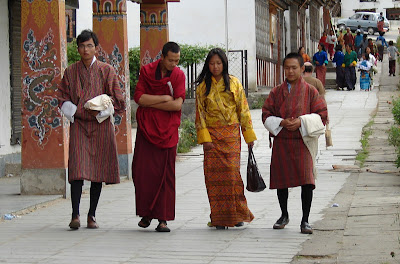
First thing you would notice in the streets of Bhutan is the colorful national dress: gho for men and kira for women. Although many people, especially teenagers, wear jeans, sports shoes, T-shirt, jacket and baseball hats, still you can see equal numbers dressed traditionally. The national dress was introduced during the 17th century to give the Bhutanese a unique identity and it became the required dress in public in the 1980s. I heared that about 10 years ago a local person could get arrested for wearing a pair of trousers in the street instead of the traditonal clothes. Not anymore. Today, the regulations are more relaxed, but still, in an effort to preserve and promote its cultural heritage, all Bhutanese are required to wear the national dress in government offices, schools, monasteries and on formal occasions.  

Nowadays it is fairly common to see people mixing traditional with modern clothes, especially covering the dress with a fake The North Face jacket on a colder day.


If you want to bring a useful gift to a Bhutanese man, get him a pair of pyjamas. No, not the one you would wear during the night! Here, they are called pyjamas, but they are, in fact, long polypropylene thermal underwears that come very handy during wintertime to keep one's legs warm. I wonder about the market for 'pyjamas' in Scotland...

Two friends 'on the gho'
Older man and his gho

Girls without the traditional kira

https://blogger.googleusercontent.com/img/b/R29vZ2xl/AVvXsEi2u7mAFSKZoZ2S9kXUVC0InUFOL1fWgIZGP5NxMKgXriRsJ2-RTnXVAsfk1C7YOV_1hWzIPtMI8P6e3yzJe9FwIltid1IGDFCTMXcnC0rrnK3W_xD17OJDZeDMJP6O9tFBQghrMnI6vn8/s1600/national+dress.jpg
This is not my photo, but a good illustration of local dresses.

Suja, the salted butter tea
Drinking tea with butter is common in Tibet and Bhutan. This 'energy drink' is called suja in Bhutan and made by churning or stirring salted black tea and yak - or most of the time cow - butter. It is strange to drink it for the first time as your mind expects a tea or coffee and your mouth gets a soup. As a guest, you are always served a cup of suja and you quickly learn to appreciate it. I had my best suja at the home of my colleague, Dorji Tashi,  made by his sister with a little bit of ginger in it. Delicious !


Doma, the betel nut
Doma drives me nuts. Doma spots are everywhere, blood-looking stains on people's mouth are common. It is forbidden to chew doma in the cinema, but it is, I feel, chewed everywhere else. Areca nut is commonly referred to as "betel nut" as it is often chewed wrapped in betel leaves with lime. The effect of chewing betel and the nut is relatively mild and could be compared to drinking a cup of coffee. When I tried a bit of areca nut without the 'garnish' I felt dizzy and uncomfortable. Yesterday in the countryside, I asked a man to take me back to Thimphu and he apologized for the smell of his doma. He said he didn't feel any special effect and he used doma as a chewing gum.
Areca nut

In the region, there was also a custom to chew areca nut and betel leaf among lovers because of its breath-freshening and relaxant properties. Hence there was a sexual symbolism attached to the chewing of the nut and the leaf. The areca nut represented the male and the betel leaf the female principle. 

Selling doma in Thimphu
Regularly chewing doma causes the lips and tongue to be stained red, an ancient equivalent of modern lipstick. Some find a woman's lips coloured by red doma sexy, but I have to say I don't. 

Some of the liquid in the mouth is usually disposed of by spitting, producing bright red spots all over Thimphu. When I first saw them I thought it was blood...


By the way, doma doesn't just color your mouth, but also likely increases the chances of mouth cancer. Hence, new generations are no longer dedicated fans of doma.

http://farm4.static.flickr.com/3388/4608773774_ef3cd397cf_z.jpg
This is not my photo but you can see the doma effect.


TO BE CONTINUED...